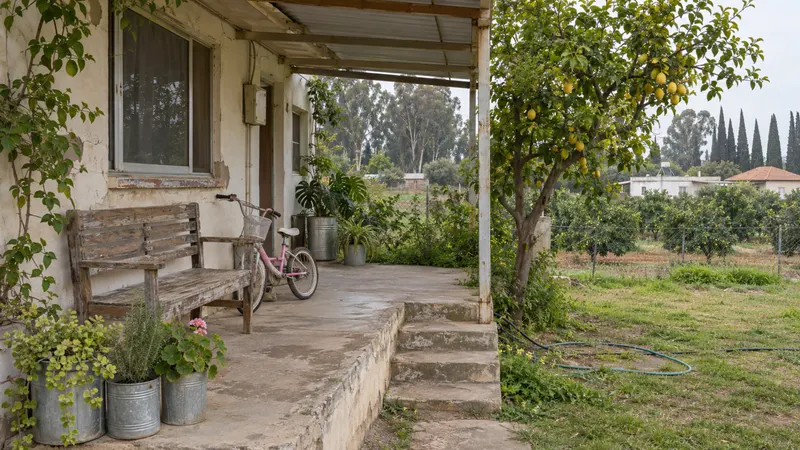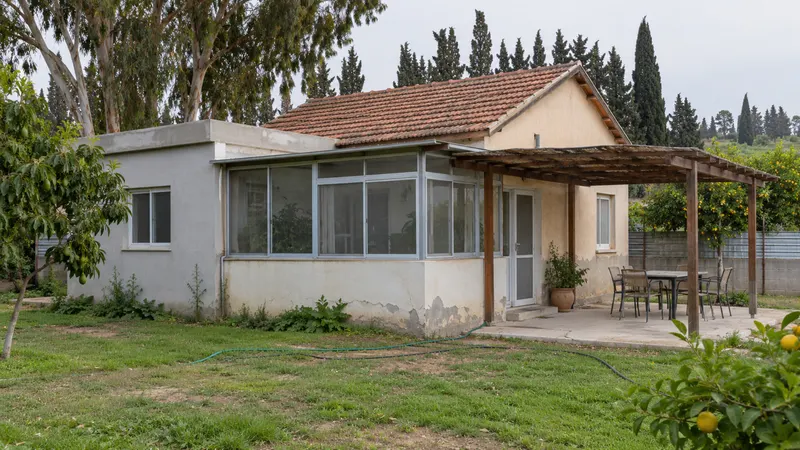
Two taxes apply to the two sides of a nahala sale (a nahala is an agricultural family holding in a moshav, a cooperative farming village): capital gains tax on real estate (mas shevach) on the seller, and purchase tax (mas rechisha) on the buyer. For both, the nahala is not taxed as a single unit: the home gets the rules for a residence, and the rest of the farm is taxed separately. The sources are the Real Estate Taxation (Capital Gains and Purchase) Law, 5723-1963, and the Purchase Tax Regulations made under it, 5735-1974. The amounts below are based on the provisions of the law and on the Israel Tax Authority's implementation instructions, including Real Estate Taxation Implementation Instruction 1/2026, and should be adjusted to the date of the transaction.
How is a nahala split for tax purposes?
- For purchase tax: regulation 16 defines the net value as the value of the land of the agricultural holding less the value of the building used for residence. A building used for residence includes the land it stands on, of an area three times the total area of the building.
- For capital gains tax: section 49G(b) of the law (49ז in Hebrew) provides that the rules for a residence whose price is affected by rights to build more also apply to the sale of an agricultural holding that includes the seller's home, when the home cannot be sold separately. The price is divided into the value of the dwelling, meaning what it would fetch without the additional building rights, and the remainder, treated as the sale of another right in land.
Capital gains tax: who pays, and how much?
Capital gains tax is charged on the gain in the sale of a right in land, and the gain is the amount by which the sale value exceeds the balance of the purchase value (section 6). The seller is liable to pay it (section 15).
As a rule, for an individual the tax rate on the real gain attributed to the period from 1 January 2012 is up to 25%; for rights acquired before then, a calculation that divides the gain into periods and different tax rates may apply, subject to special provisions. Where the right was acquired before 7 November 2001, the gain is divided into periods: the part up to that date is taxed at the highest marginal income tax rate, the part up to 1 January 2012 at up to 20%, and the rest at a rate of up to 25% under section 48A(b1); in addition, surtax may apply, depending on the seller's income, the type of gain and the provisions of section 121B of the Income Tax Ordinance. Since 2025 there is also an additional tax of 2% on taxable income from capital sources above the ceiling, alongside the 3% surtax, subject to the conditions of the law.
The single-residence exemption and its limits in a nahala
Section 49B(2) allows an exemption on the sale of a qualifying residence, subject to all the conditions of the law, among them that it is the seller's only residence in Israel and in the Area (as defined in the law), the required holding period, and no previous sale under this exemption within the period set by the law; the check also takes into account the family-unit rules and the exceptions concerning additional residences. A qualifying residence (dirat megurim mezaka) is a dwelling used mainly as a home for four fifths of the period for which the gain is calculated, or for the four years before the sale. The exemption is given to an Israeli resident, and to a foreign resident only on proof that he has no residence in his country of residence (section 49A(a)).
In a nahala the exemption is limited in three ways:
- The exemption covers the value of the dwelling only. Under section 49G, when the price was affected by the possibility of building more than the area sold, the exemption is given on the amount the dwelling would fetch without the additional building rights.
- The extra amount for building rights is capped. If the value of the dwelling is below ILS 2,428,100, a further exemption is given for the additional building rights: the value of the dwelling, or the difference between ILS 2,428,100 and the value of the dwelling, whichever is lower. The amount is frozen and valid until 15 January 2028.
- A value ceiling. Under section 49A(a1), when the sale value exceeds ILS 5,008,000, the exemption is given only up to the ceiling. The ceiling is frozen until 31 December 2027.
The rest of the price is treated as the sale of another right in land; the tax is calculated on the gain attributed to it, after attributing the purchase value, the allowable expenses and the adjustments under the law. The purchase value, the deductions and the additions are attributed to it proportionally (section 49G(a)(4)).
There is also a favourable calculation for a qualifying residence acquired before 1 January 2014: the real gain up to that date is exempt, and the rest is taxed at up to 25% (section 48A(b2)).
Purchase tax on buying a nahala
Purchase tax is charged on the buyer (section 9(a) of the law). Under regulation 16, when a right in land is bought in order to establish or maintain an agricultural holding, the tax is calculated in two parts:
- On the residential building: on the residential brackets in section 9 of the law. For the only residence of an Israeli resident there are five brackets: a first part on which no tax is paid, and above it rates of 3.5%, 5%, 8% and 10%. For a residence that is not the buyer's only one, two brackets of 8% and 10% apply under a temporary provision; according to Implementation Instruction 1/2025 the temporary provision is in force until 31 December 2026.
- On the net value, meaning the rest of the farm: 0.5% on the part up to a ceiling, and 5% on the part above it. The ceiling is updated every year on 16 January.
Check the brackets and ceilings in force on the date of purchase: some of the purchase tax brackets are frozen, while the ceiling of the relief for buying an agricultural holding is updated every year. They are published in the Israel Tax Authority's purchase tax simulator (in Hebrew) and in the annual real estate taxation implementation instruction; the amounts for the period up to 15 January 2026 appear in Implementation Instruction 1/2025.
Betterment levy in brief
Betterment levy (hetel hashbacha) is not a tax on the transaction but a payment to the local planning and building committee, under the Third Schedule to the Planning and Building Law, 5725-1965. Betterment is the rise in the value of land following the approval of a plan, the grant of a relaxation or the permitting of a non-conforming use, and the levy is half of the betterment.
The levy is paid no later than the realisation of the rights. Realisation is the receipt of a building permit, the start of use, or the transfer of the land or of a long-term lease in it. The person liable is the owner of the land or, if it is leased on a long-term lease (chachira le-dorot), the lessee. In cases that meet the conditions of section 21 of the Third Schedule, an arrangement of payments between the Israel Land Authority and the local authority applies in place of betterment levy; however, in a nahala the absence of a long-term lease contract alone does not mean there is no liability for the levy, because a licensee (bar reshut) may also be treated as a long-term lessee for the purpose of the charge. This point is particularly important in nahalot following the Bloch ruling (halachat Bloch).
Purchase fees (dmei rechisha) and consent fees (dmei haskama), which are paid to the Israel Land Authority, are not a tax and come on top of all of these.